A pupil rarely becomes persistently absent overnight. It usually builds quietly: a Monday here, a medical appointment there, a week off with illness. By the time a termly report shows the problem, the pattern is already set and much harder to shift.
Persistent absence means a pupil has missed 10% or more of their possible sessions, roughly one day a fortnight across a school year. Missing 50% or more is severe absence. You spot it early by checking each pupil’s attendance weekly, looking at patterns and reasons, and acting well before the 10% line is crossed.
What does persistent absence mean in England?
The DfE’s statutory guidance, Working together to improve school attendance, describes pupils who miss 10% or more of school as persistently absent, “equivalent to 1 day or more a fortnight across a full school year”. Where this happens, schools and local authorities are expected to work together to put additional targeted support in place.
The same guidance describes pupils who miss 50% or more of school, “absent from school more than they are present”, as severely absent. All partners are expected to make this group the top priority for support.
A few points are easy to miss:
- It is measured in sessions. Registered schools take a register for the morning session and again in the afternoon, so a full day is two sessions.
- Authorised absence counts. Illness and agreed leave are still absence. Persistent absence is about how much education is missed, not about blame.
- Part-time timetables count too. DfE guidance says sessions missed because of an agreed part-time timetable are recorded with code C2, which is classified as authorised absence. A pupil on a reduced timetable at a registered school can therefore meet the persistent absence threshold even if they attend every session they are asked to.
Our glossary entry on persistent absence has a quick-reference summary.
What about Wales?
The Welsh Government changed its official threshold for persistent absence from 20% to 10% of the most common number of required sessions. Its attendance and absence quality report explains how the measure is calculated for maintained schools. If you work with Welsh local authorities, check how they want attendance reported for the pupils they place with you.
Who does it apply to?
The DfE guidance is statutory for maintained schools, academies and independent schools, and it names alternative provision providers among the people it is for.
- Pupil referral units and AP academies keep their own statutory registers, so persistent absence applies to their pupils in the usual way.
- Independent schools, including many special schools, must keep attendance registers, and the guidance applies to them, although they are not required to submit daily attendance data to the DfE.
- Unregistered AP providers do not keep the statutory register themselves. The pupil’s home school records their attendance, and the guidance expects the provider to tell the school about any absence. Your records feed straight into the school’s figures, so accuracy matters.
How do you spot it early?
The guidance asks schools not to focus only on pupils already over the line, but to look at all levels of absence so pupils can be supported “before patterns become entrenched”. In a small setting, that can be a simple weekly routine:
- Check every pupil’s attendance to date, every week. A pupil at 93% in October is not yet persistently absent but is heading that way.
- Look at the direction, not just the number. Three weeks of decline matters more than a single bad week.
- Look for patterns. The same weekday, the same session, the same site, or absences clustered around a particular activity or transport arrangement.
- Read the reasons. “Ill” every Monday tells a different story from a hospital stay. Consistent reasons from your own list make patterns visible.
- Talk early. A friendly conversation with the pupil and family at the first sign of a dip is far easier than a formal meeting later.
- Tell the commissioner. If a school or local authority placed the pupil, share concerns promptly rather than waiting for the half-termly report.
What does this look like in practice?
Consider a PRU with 40 pupils across two sites. At the end of September the head reviews attendance by pupil. One Year 10 pupil is at 91%, above the persistent absence line, so nobody is worried. But a closer look shows every missed session is a Monday morning, and the reason recorded is “transport”.
A quick call reveals the taxi for that route changed drivers and the pupil will not get in with someone new. The PRU raises it with the local authority’s transport team, a familiar driver is reinstated, and attendance recovers. Had the team waited for the termly report, the pupil would likely have crossed 10% and the Monday habit would have been much harder to break.
What should you do once a pupil is persistently absent?
Keep the focus on removing barriers. The DfE guidance expects, at a minimum, a meeting with the pupil and their parents to understand what is getting in the way and agree actions, reviewed regularly. That may involve the home school, the local authority’s attendance team, health services or social care. Keep clear notes of what was agreed and when it will be reviewed.
How PupilDB helps
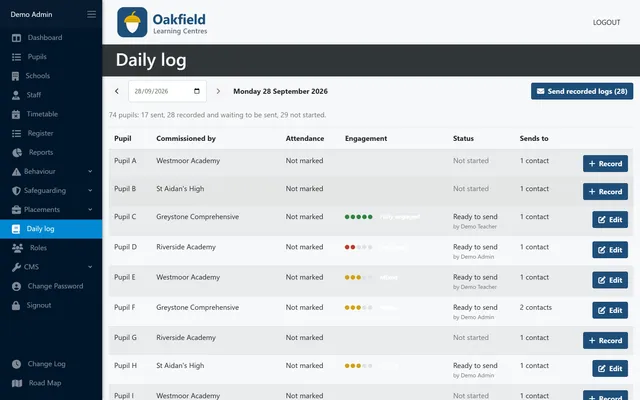
PupilDB builds registers from your timetable, records absence reasons from your own list with notes, and emails reminders when a register has not been finished, so gaps are less likely in the first place. The attendance percentage by month report (September to August) makes it easy to see which pupils are slipping, and automatic persistent-absence alerts are on our roadmap. See registers and attendance, reports and how we support alternative provision.